PM Modi to Inaugurate Navi Mumbai Airport Today: 7 Facts About Ind
News THE ECONOMIC TIMES, livelaw.in, LAW, LAWYERS NEAR ME, LAWYERS NEAR BY ME, LIVE LAW, THE TIMES OF INDIA, HINDUSTAN TIMES, the indian express, LIVE LAW .IN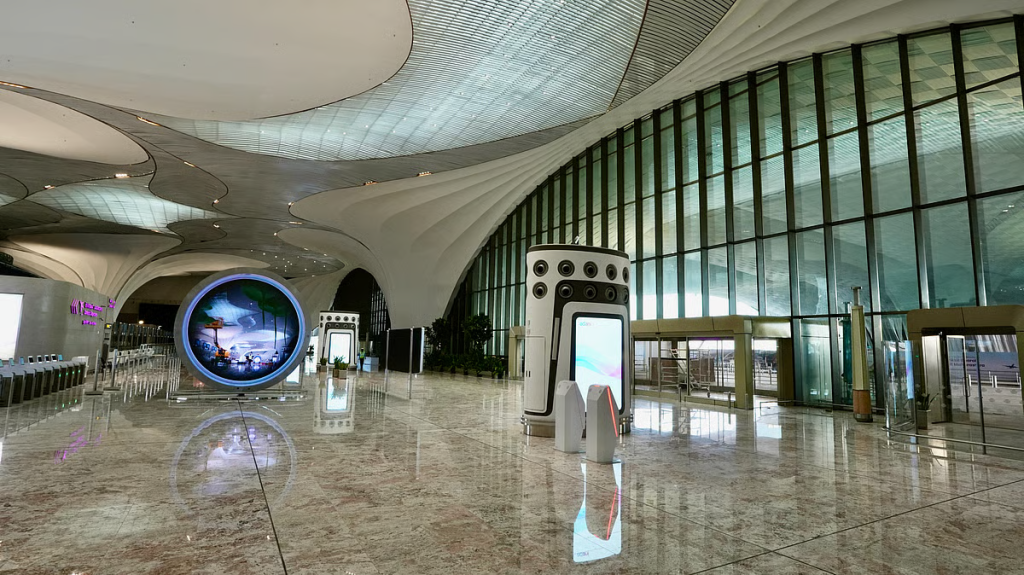
Set to be inaugurated in Ulwe, Navi Mumbai, the new airport aims to blend smart infrastructure, green design, and seamless digital operations — here’s what to know.
Navi Mumbai: 8 October 2025
Navi Mumbai / Mumbai / Maharashtra —
Prime Minister Narendra Modi will inaugurate the Navi Mumbai International Airport (NMIA) in Ulwe today, marking a watershed moment in India’s aviation journey and promoting it as the country’s first fully digital airport. With its launch, NMIA aims to relieve pressure from Mumbai’s existing air hub, introduce futuristic airport infrastructure, and redefine standards for digital aviation and smart operations in India.
Developers built NMIA as a greenfield airport, making it the next milestone in Mumbai’s air connectivity ambitions and earning it the title of the second airport for the Mumbai Metropolitan Region, complementing Chhatrapati Shivaji Maharaj International Airport.
In this article, we explore how NMIA integrates airport infrastructure, fully digital operations, DGCA licensing, and multimodal connectivity, and what it means for India’s aviation future.
1. A “Fully Digital” Airport from Day One
One of NMIA’s headline features is its ambition to be India’s first fully digital airport. From backend systems to passenger-facing operations, the airport will rely heavily on real-time data, automation, and seamless connectivity.
A key innovation is its “digital twin” architecture: a system that mirrors operational parameters — baggage flow, queue lengths, aircraft movement, staff coordination — in real time to all stakeholders. This enables coordinated decision-making across airlines, security agencies, ground handlers, and airport management.
This digital backbone means fewer paper-based processes, more predictive maintenance, better resource utilization, and potentially faster turnarounds. While passengers can still opt for physical boarding passes, designers have made much of the airport’s internal operations data-driven and interconnected from Day 1.
This approach is a step beyond earlier smart airport models, pushing India into the realm of advanced digital aviation.
2. DGCA License & Regulatory Readiness
No airport can begin operations without regulatory sanction. For NMIA, securing a valid aerodrome license from the Directorate General of Civil Aviation (DGCA) is fundamental.
Officials have reportedly held reviews to assess NMIA’s preparedness, including runway safety, navigation aids, air traffic control systems, and compliance with safety norms.
While the formal inauguration signals readiness in infrastructure, actual commercial flight operations will begin once all DGCA clearances, airline approvals, and safety trials are complete — possibly in a phased manner.
The DGCA’s endorsement will validate NMIA’s claim as a smart, modern, and safe airport, and it must monitor ongoing compliance, especially given its digital systems and integration with many stakeholders.
3. Infrastructure & Capacity Plans
Developers are constructing NMIA in phases, with the first phase targeting a capacity of 20–25 million passengers per year.
Planners envision the airport scaling up to 90 million annual passengers once all terminals and the second runway become functional.
Architects have created futuristic terminal designs, and developers are executing the project through a public-private partnership (PPP) under the Design-Build-Finance-Operate-Transfer (DBFOT) model. CIDCO and Adani Airports share ownership.
Cargo infrastructure is integral from Phase 1, with dedicated cargo terminals to support freight operations alongside passenger services.
Engineers built the airport’s 3,700-meter runway (08/26) to handle international operations and equipped it with modern navigational aids.
Planners laid out NMIA not just as a supplementary airport but as a future-forward hub built for scale and flexibility.
4. Multimodal Connectivity & Access
An airport is only as effective as its connectivity. Developers designed NMIA with multiple access modes in mind.
- Road: It connects to NH 4B (348), the Sion–Panvel highway, and via planned coastal roads like Ulwe Coastal Road to the Mumbai Trans Harbour Link.
- Targhar railway station will interface with the airport, and Navi Mumbai Metro Line 1 along with the proposed Mumbai Metro Line 8 (Gold Line) will serve it.
- Future multimodal links: As the airport expands, planners envisage integration across road, rail, metro, and possibly other modes to ensure smooth last-mile access.
By positioning itself as a hub in a transport network, NMIA aims to minimize access friction and make itself accessible across the Mumbai metropolitan region and beyond.
5. Strategic Role as Mumbai’s Second Airport
Mumbai’s existing airport, CSMIA, is operating close to its capacity limits.Developers designed NMIA to serve as Mumbai’s second commercial airport, absorb overflow, enable route decongestion, and create redundancy.
Authorities plan to gradually shift general aviation traffic (business jets and charters) to NMIA, freeing capacity at the older airport.
The twin-airport model enhances regional resilience by allowing operators to divert or distribute flights when one airport faces constraints such as weather, maintenance, or capacity limits. It also positions Mumbai to compete globally as a multi-hub city in air connectivity.
6. Challenges & Critical Success Factors
While ambition is high, NMIA faces several hurdles:
- Some ancillary projects — connecting roads, public transit lines, and last-mile links — have fallen behind schedule, creating a risk of bottlenecks after the launch.
- Weather / delays: Monsoon rains and other weather disruptions have already pushed inauguration timelines.
- Synchronization with DGCA approvals: Delays or mismatches in obtaining safety certifications can delay flight operations even after formal inauguration.
- Cybersecurity & system robustness: As a highly digital airport, NMIA must guard against cyber threats, data failures, and system outages. Redundancies and fallback protocols are crucial.
- Operational coordination: Multiple stakeholders — airlines, ground handlers, security agencies — must align workflows and data on the shared digital platform.
- As usage scales, authorities must smoothly manage air corridors, runway capacity, and traffic sequencing to prevent congestion.
7. What It Means for India’s Aviation Future
NMIA’s launch is not just a local milestone — it signals a shift in how India conceives airport infrastructure and digitalization. Some broader implications:
- It raises the bar for smart airports in India, making fully digital operations not a novelty but an expectation.
- It may encourage other airports to adopt digital twin models and data-driven operations.
- It strengthens Mumbai’s position as a global aviation hub, helping draw more international connectivity.
- It showcases a successful greenfield airport model combining private innovation and public oversight.
- It may trigger competitive responses — other cities or states might accelerate their airport upgrades to match NMIA’s capabilities.
With all systems in place, NMIA embodies the convergence of airport infrastructure, digital aviation, and smart operations in India’s next wave of aviation growth.
Source:

