PM Modi Meets UK Prime Minister Keir Starmer at Raj Bhawan, Mumbai
News THE ECONOMIC TIMES, livelaw.in, LAW, LAWYERS NEAR ME, LAWYERS NEAR BY ME, LIVE LAW, THE TIMES OF INDIA, HINDUSTAN TIMES, the indian express, LIVE LAW .IN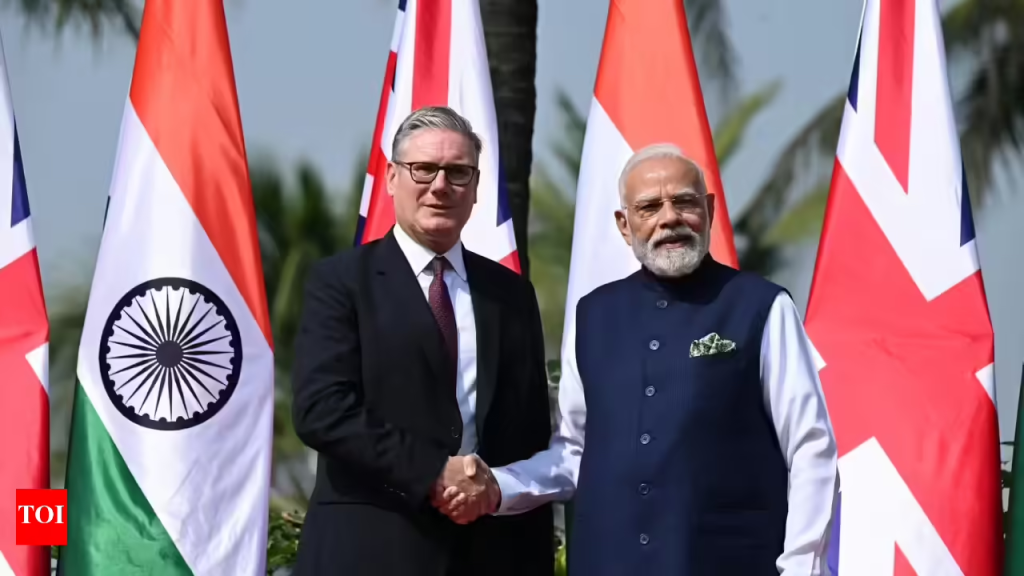
PM Modi and UK PM Keir Starmer discuss trade, defense, and tech ties at Mumbai’s Raj Bhawan.
Mumbai, India — Thursday, October 9, 2025
PM Modi Meets Keir Starmer at Raj Bhawan, Mumbai
In a significant diplomatic engagement underscoring the growing warmth in India–UK relations, Prime Minister Narendra Modi met his British counterpart Keir Starmer at Raj Bhawan, Mumbai, on Thursday. The meeting marked Starmer’s first official visit to India since assuming office, and came amid a broader push to revive bilateral trade talks and strengthen cooperation in defense, clean energy, and emerging technologies.
The high-profile dialogue was seen as a pivotal step toward rejuvenating the India–UK Comprehensive Strategic Partnership, which both leaders described as “essential for shaping the global future through innovation, trust, and shared democratic values.”
Strengthening Economic and Trade Ties
A key highlight of the discussions was the progress on the long-anticipated India–UK Free Trade Agreement (FTA), which has seen several rounds of negotiations over the past two years.
Prime Minister Modi emphasized India’s commitment to a “mutually beneficial and balanced” agreement that boosts trade, investment, and job creation on both sides.
“India and the United Kingdom share a strong history and a dynamic present. Together, we can build a future of prosperity and innovation,” Modi said during the joint briefing.
Starmer, echoing this sentiment, reaffirmed the UK’s desire to deepen its economic engagement with India, especially in the post-Brexit landscape.
“The United Kingdom sees India not just as a trade partner, but as a trusted friend and a force for good in the world,” Starmer stated. “Our collaboration across technology, sustainability, and education reflects a relationship built on respect and ambition.”
The two leaders reviewed ongoing negotiations and instructed their teams to finalize the FTA framework by early 2026, focusing on market access, digital services, and sustainable supply chains.
Focus on Technology, AI, and Innovation
Technology and innovation dominated the second half of the meeting, with both sides highlighting the potential for collaboration in artificial intelligence (AI), quantum computing, fintech, and green technologies.
India’s rapidly growing tech ecosystem and the UK’s innovation-driven economy were described as “natural allies in the digital age.” Modi invited British firms to invest in India’s Digital India 2.0 and Make in India programs, emphasizing the country’s progress in semiconductor manufacturing, renewable energy, and start-up incubation.
“Innovation defines the next frontier of our partnership,” Modi said. “Whether it is AI governance, green mobility, or cybersecurity, India and the UK can lead global solutions.”
Starmer announced a new initiative — the UK-India Tech Connect 2025 — which will foster joint research between top universities and startups across both countries, supported by public and private funding.
Defense and Security Cooperation
In light of evolving global security challenges, Modi and Starmer also discussed defense collaboration and maritime security in the Indo-Pacific region. The two sides reaffirmed their commitment to maintaining a free, open, and rules-based Indo-Pacific and pledged to enhance defense manufacturing and joint exercises.
India is expected to host the next round of UK-India Defense Consultations in New Delhi early next year. Discussions also covered counterterrorism cooperation, intelligence sharing, and efforts to combat emerging security threats, including cyber warfare and maritime piracy.
Climate Change and Sustainable Development
Both leaders reiterated their commitment to the Paris Agreement and discussed expanding cooperation on renewable energy, especially in solar, wind, and green hydrogen sectors.
Starmer praised India’s leadership in sustainable development through initiatives like the International Solar Alliance (ISA) and Mission LiFE (Lifestyle for Environment), while Modi acknowledged the UK’s contributions to global climate financing.
“Climate action cannot wait,” Modi remarked. “India and the UK must lead by example in clean growth and green innovation.”
Starmer announced an additional £150 million commitment toward joint clean energy projects under the UK-India Green Growth Partnership.
Education, People-to-People, and Cultural Exchange
The leaders also emphasized the importance of education and cultural ties — key pillars of the India–UK relationship. Modi and Starmer jointly launched the India-UK Scholars Network, aimed at promoting academic collaboration and student exchange programs between top institutions such as IITs, IIMs, Oxford, and Cambridge.
Visa and mobility issues were also discussed, with Starmer expressing his government’s intention to ensure smoother processes for Indian professionals and students.
“Our greatest strength lies in our people,” Starmer said. “Every student, every innovator, every business leader connecting our nations adds to the living bridge between India and the UK.”
Global Issues and Shared Vision
The two prime ministers also exchanged views on pressing global challenges, including the ongoing humanitarian crises, counterterrorism, digital governance, and the situation in West Asia and Eastern Europe.
Both reiterated their shared vision for multilateral reform, particularly within the United Nations, and reaffirmed support for India’s permanent seat on the UN Security Council.
Starmer underscored that the UK “strongly supports India’s leadership role in global peace and sustainable development.”
Symbolism of the Mumbai Meeting
Holding the meeting in Mumbai’s Raj Bhawan, instead of New Delhi, carried symbolic weight. Mumbai represents India’s economic dynamism and global connectivity — reflecting the spirit of modern partnership both leaders aim to cultivate.
Following their bilateral discussions, Modi and Starmer attended a business roundtable featuring top CEOs from Reliance Industries, Tata Group, Infosys, Rolls-Royce, and HSBC.
The leaders also paid floral tributes at the Gateway of India, celebrating 75 years of India–UK diplomatic relations.
A New Chapter in India–UK Relations
The Modi–Starmer meeting signals a renewed momentum in India–UK diplomacy. With both countries emphasizing economic resilience, technological cooperation, and climate responsibility, the partnership appears poised for a transformative leap.
“The bond between our nations is stronger than ever,” Modi said. “Together, India and the UK can create a blueprint for peace, prosperity, and progress.”
Starmer concluded, “The UK stands shoulder-to-shoulder with India — in friendship, in opportunity, and in the belief that our best days lie ahead.”
The visit concluded with a joint declaration reaffirming their commitment to “a future built on democracy, inclusivity, and shared prosperity.”
Source: