‘Bold & Precise Attacks’: IAF Chief Reflects on Operation Sind
News THE ECONOMIC TIMES, livelaw.in, LAW, LAWYERS NEAR ME, LAWYERS NEAR BY ME, LIVE LAW, THE TIMES OF INDIA, HINDUSTAN TIMES, the indian express, LIVE LAW .IN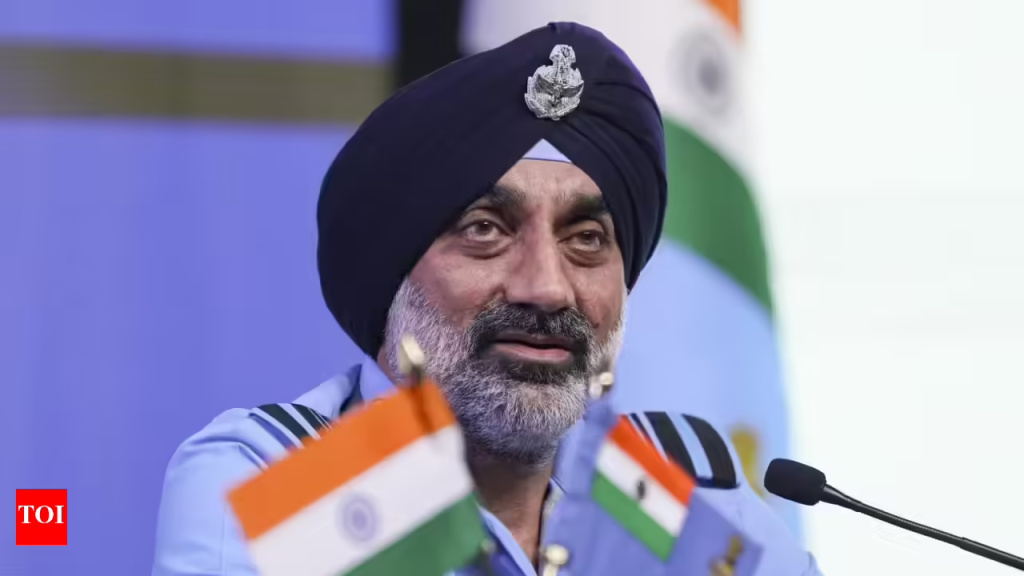
Air Chief Marshal V. R. Chaudhari praises the Indian Air Force’s decisive operations under Op Sindoor, emphasizing technological self-reliance and the strength of home-grown defence systems.
New Delhi : October 8, 2025
Air Chief Marshal Vivek Ram Chaudhari, Chief of the Indian Air Force (IAF), lauded the force’s “bold and precise” strikes during Operation Sindoor, calling it a testament to India’s growing prowess in indigenous defence technology. Speaking at the annual IAF Day press briefing in New Delhi, the Air Chief underscored how the operation showcased not only tactical excellence but also the reliability of home-grown systems that now form the backbone of India’s air warfare capabilities.
“Operation Sindoor exemplifies what modern India stands for — courage, clarity, and capability,” the IAF Chief said. “Our pilots executed missions with surgical accuracy, enabled by indigenous systems that performed beyond expectations.”
Operation Sindoor: Precision Meets Self-Reliance
Operation Sindoor, conducted earlier this year, was reportedly a limited yet high-impact mission targeting strategic enemy positions across the border using precision-guided munitions. While details of the operation remain classified, defence sources confirm that the IAF used indigenously developed standoff weapons, surveillance platforms, and electronic warfare systems, marking a significant milestone in India’s operational autonomy.
According to officials, Tejas Mk-1A fighters, Su-30MKIs, and Netra AEW&C aircraft played central roles in the operation, all equipped with DRDO-developed avionics, data links, and smart munitions. The mission’s success validated India’s focus on “home-built strength” under the Atmanirbhar Bharat initiative.
“The accuracy we achieved during Op Sindoor proves that our indigenous ecosystem — from sensors to shooters — is now combat-ready,” said an IAF official involved in the mission.
‘Make in India’ in the Skies
The IAF Chief emphasized that the force’s transformation rests on indigenization and modernization, driven by the “Make in India” vision. He highlighted that over 70% of new IAF acquisitions in the pipeline are either fully Indian or developed through joint ventures with domestic industries.
From the Astra beyond-visual-range missiles and Akash NG air defence systems to ALH Dhruv and LCH Prachand helicopters, the IAF’s frontline assets now reflect a sharp rise in indigenous content.
Chaudhari also mentioned that upcoming platforms such as the Advanced Medium Combat Aircraft (AMCA) and Tejas Mk-2 will further reduce foreign dependency. “We are not just buyers anymore — we are builders,” he said. “Operation Sindoor was proof that the sky is no longer the limit for Indian innovation.”
Lessons in Modern Warfare
Operation Sindoor has been viewed as a case study in network-centric warfare, integrating real-time data from multiple platforms through the Integrated Air Command and Control System (IACCS). The IAF effectively combined satellite imagery, radar feeds, and airborne early warning inputs to execute time-sensitive strikes.
Analysts say this marks a major doctrinal shift for the IAF — from platform-centric to system-centric warfare, where the emphasis lies on situational awareness, speed of decision-making, and precision engagement.
“Modern warfare is no longer about who has more aircraft, but who has smarter integration,” said defence analyst Lt. Gen. (Retd.) Anil Ahuja. “The IAF’s execution under Op Sindoor indicates it has embraced this transformation fully.”
Indigenous Systems Take Center Stage
Among the systems credited for Op Sindoor’s success were:
- DRDO’s Smart Anti-Airfield Weapon (SAAW) for deep-strike precision.
- Bharat Electronics’ radar systems providing real-time tracking and coordination.
- BEL and HAL-developed avionics suites for Tejas and Su-30MKI aircraft.
- Locally produced guidance kits that improved strike accuracy and survivability.
These technologies, previously considered experimental, have now proven their combat worth, significantly boosting India’s confidence in its defence manufacturing ecosystem.
From Balakot to Sindoor: A Decade of Evolution
Observers have drawn comparisons between Operation Sindoor (2025) and the Balakot airstrikes of 2019, noting how India’s aerial warfare capabilities have evolved in just six years. Unlike Balakot, where imported systems and munitions dominated, Sindoor showcased self-reliant warfare, backed by AI-driven mission planning, real-time telemetry, and indigenous targeting pods.
“This operation symbolizes India’s shift from reactive defence to proactive deterrence,” said retired Air Marshal Anil Chopra, Director General, Centre for Air Power Studies. “We’ve moved from dependence to dominance.”
The Road Ahead
The Air Chief announced that the IAF is now focusing on:
- Expanding the Tejas Mk-1A fleet to replace aging MiG-21s.
- Fast-tracking the AMCA fifth-generation fighter program.
- Integrating AI-based mission systems across combat fleets.
- Enhancing domestic production of spare parts and maintenance systems.
- Collaborating with the private sector to scale indigenous manufacturing.
“Our aim is clear — India must not only fight with indigenous systems but also lead in aerospace technology,” Chaudhari affirmed.
A Message of Confidence
As India celebrates Air Force Day, the message from the skies is clear: self-reliance is not a slogan — it is a strategy.
Operation Sindoor stands as a milestone in India’s journey toward strategic autonomy, with the IAF proving that indigenous technology can deliver under combat conditions. “We demonstrated precision, discipline, and indigenization — three pillars of the new Indian Air Force,” said Chaudhari, concluding his address.
Source;

