AI Reworks the Market’s Maths: How Artificial Intelligence Is Resh
News THE ECONOMIC TIMES, livelaw.in, LAW, LAWYERS NEAR ME, LAWYERS NEAR BY ME, LIVE LAW, THE TIMES OF INDIA, HINDUSTAN TIMES, the indian express, LIVE LAW .INFrom trading floors to fund management, AI is rewriting the logic of markets — turning data into predictive power, redefining valuation models, and challenging human intuition.
Mumbai, November 11, Tuesday, 2025
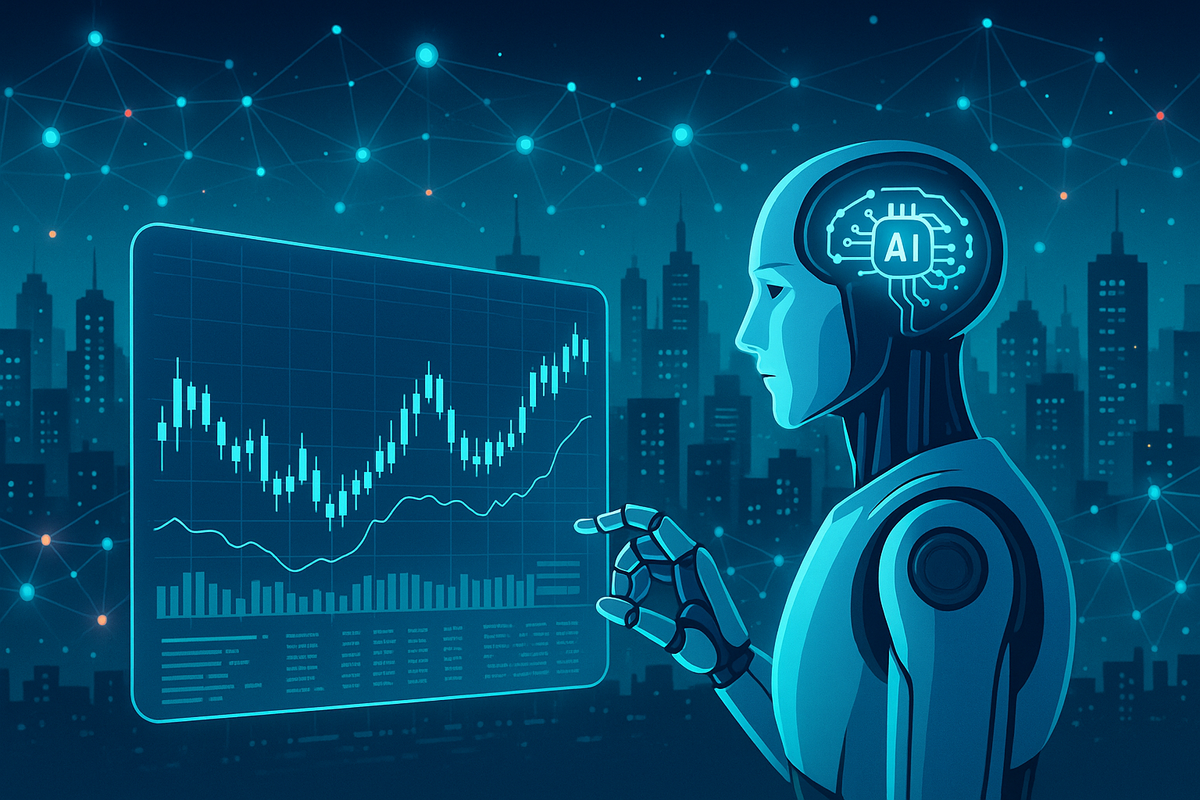
Artificial intelligence is no longer just a tool for automation — it has become the central brain of the modern financial markets. Across global exchanges, fund houses, and brokerage firms, AI algorithms are redefining how assets are valued, traded, and forecasted, altering decades of financial wisdom in the process.
According to market analysts, 2025 marks the tipping point where AI-led decision-making outpaces human analysis in terms of accuracy, speed, and adaptability. With trillions of data points flowing every second, the math that once guided global markets is being rewritten by code — one prediction at a time.
From Wall Street to Dalal Street: The Rise of Machine-Led Investing
AI has quietly evolved from assisting analysts to leading trading strategies outright. In global equity markets, more than 70% of daily trading volume is now generated by AI-powered algorithms.
“Markets have become too complex for traditional models,” said Ravi Subramanian, Chief Data Officer at Axis Securities. “AI doesn’t just track prices — it interprets patterns, anticipates sentiment, and adjusts portfolios faster than human analysts ever could.”
Machine learning models now predict everything from earnings movements and commodity prices to social media-driven market sentiment, using data that conventional valuation models can’t even process.
AI’s predictive engines, capable of analyzing satellite images, credit card data, weather trends, and even retail foot traffic, are transforming how investors interpret economic signals.
How AI Is Changing the Market Formula
In the old world of finance, market math revolved around ratios — P/E multiples, EPS growth, and price-to-book values. Now, AI’s models factor in millions of hidden variables: consumer emotion, macroeconomic indicators, social chatter, and even geopolitics.
“AI converts unstructured data into dynamic forecasts. It doesn’t look for averages — it looks for anomalies,” explained Dr. Priyanka Menon, a fintech researcher at IIM Ahmedabad.
This shift has given rise to quantum investing — where portfolios evolve autonomously through self-learning algorithms that recalibrate exposure every few minutes. The result: micro-volatility but macro-stability, as AI-driven systems trade in millisecond bursts, constantly rebalancing risk.
India’s Markets Join the AI Revolution
The AI wave isn’t limited to Wall Street. Indian markets, too, are experiencing a data-driven renaissance. Domestic fund houses like Nippon India, ICICI Prudential, and Zerodha Quant have deployed AI-led systems to analyze stock momentum, liquidity patterns, and retail participation in real-time.
According to NSE’s annual tech report, algorithmic and AI-based trades now account for over 52% of equity derivatives volume in India, compared to 38% just two years ago.
AI in Indian investing is being used to:
- Detect early market anomalies before volatility spikes.
- Predict FII and DII fund flow movements.
- Optimize asset allocation across sectors using predictive analytics.
- Flag fraudulent trading activity and data inconsistencies.
“Indian markets are moving toward full predictive intelligence,” said Amitabh Sharma, Head of Quant Strategies at Motilal Oswal. “We’re no longer trading on gut — we’re trading on precision.”
The Rise of AI Fund Managers
Globally, asset management firms have begun appointing AI systems as co-managers alongside human fund heads. These systems not only recommend trades but also execute them autonomously within pre-set ethical and compliance frameworks.
AI-driven funds, like those managed by BlackRock’s Aladdin platform and JP Morgan’s LOXM, have outperformed human-led portfolios by as much as 12–18% annually, thanks to continuous learning loops and predictive optimization.
In India, similar models are emerging. Firms such as Tata Mutual Fund and Edelweiss AMC have begun testing hybrid portfolios where AI determines entry and exit points, while humans validate macroeconomic context.
AI’s Double-Edged Sword: Efficiency Meets Instability
While AI brings precision, it also amplifies systemic risks. The flash crash of April 2025, triggered by automated sell-offs across Asian exchanges, exposed how interconnected algorithmic systems can create self-reinforcing spirals.
“AI agents can misinterpret short-term data anomalies as global shifts,” warned Sanjay Bhatnagar, a financial systems analyst at Deloitte. “Without human oversight, you can have a perfect model making catastrophic assumptions.”
Regulators are now exploring AI-specific circuit breakers and ethical compliance frameworks to prevent runaway algorithms from destabilizing markets. The Securities and Exchange Board of India (SEBI) is working on new AI Audit Protocols, requiring brokers and funds to disclose algorithmic logic and risk controls.
Data Becomes the New Alpha
In the AI-driven era, data has replaced intuition as the most valuable market asset. Hedge funds now pay millions for access to exclusive alternative datasets, from drone footage of supply chains to satellite imagery of retail activity.
AI converts these diverse inputs into actionable predictions, effectively turning data diversity into trading advantage.
“The edge in 2025 isn’t about who’s faster — it’s about who’s smarter,” said Menon. “AI gives investors the ability to see what others can’t, weeks before the market reacts.”
The Human Element Still Matters
Despite AI’s growing dominance, experts agree that human intuition and judgment remain irreplaceable. Machine models still struggle to interpret macro shocks, such as political crises, regulatory changes, or black swan events.
“The best results come from human–AI collaboration,” said Sharma. “AI does the heavy lifting, but humans provide context and caution.”
In essence, the future of investing will be a blend of algorithms and experience, with machines handling speed and scale, while humans ensure ethical and strategic balance.
The Future: Markets Without Math as We Know It
AI’s growing influence is dismantling long-held theories like Efficient Market Hypothesis (EMH) and Modern Portfolio Theory (MPT). Markets are no longer purely rational; they’re adaptive ecosystems guided by self-learning algorithms that update their “beliefs” constantly.
What once took analysts hours now takes AI seconds. What once required human intuition now requires data-driven intelligence.
“AI isn’t just reworking the market’s math — it’s rewriting its DNA,” said Subramanian. “The traders of tomorrow won’t need spreadsheets; they’ll need algorithms.”
Source:

