BJP opposition clash on judiciary.
News HINDUSTAN TIMES, the pioneer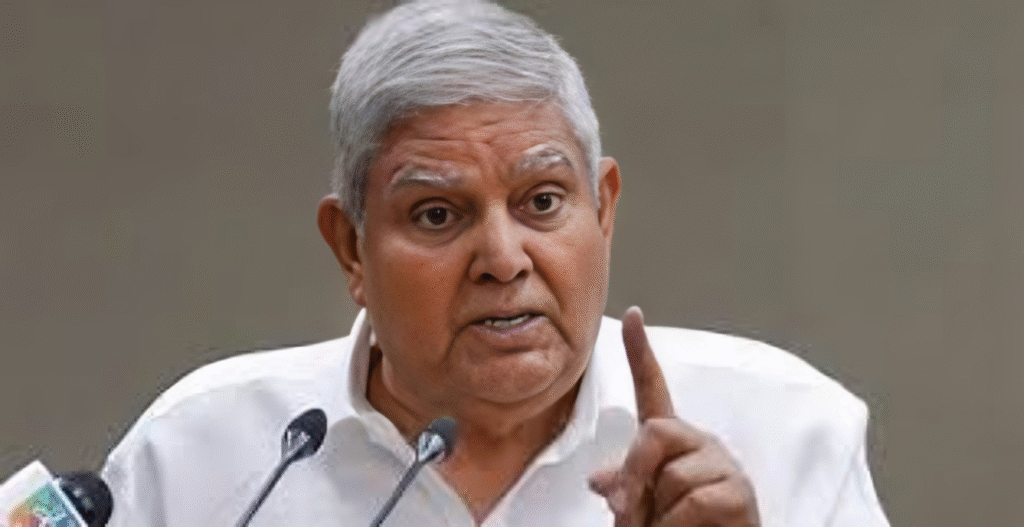
Vice President Jagdeep Dhankhar’s recent remarks criticizing the judiciary have ignited a significant political controversy, drawing sharp reactions from opposition parties and a staunch defense from the Bharatiya Janata Party (BJP).
Dhankhar’s Controversial Remarks
On April 17, 2025, during an address to Rajya Sabha interns, Vice President Dhankhar described Article 142 of the Indian Constitution—which empowers the Supreme Court to pass orders necessary for “complete justice”—as a “nuclear missile against democratic forces” accessible to the judiciary at all times. He also questioned the judiciary’s authority to set timelines for the President’s assent to state bills and raised concerns about the judicial process requiring approval for FIRs against judges.
Opposition’s Response
Opposition leaders have condemned Dhankhar’s statements, accusing him of undermining the judiciary and breaching constitutional propriety.
- Congress MP Randeep Singh Surjewala emphasized that “only the Constitution is supreme in our democracy,” criticizing Dhankhar for attempting to override constitutional checks and balances.
- Trinamool Congress MP Kalyan Banerjee labeled Dhankhar’s comments as “highly objectionable” and indicative of a “repeated disregard for constitutional institutions.”
- DMK leader Tiruchi Siva described the remarks as “unethical,” asserting that no individual, regardless of their position, can indefinitely stall legislative processes under the guise of constitutional authority.
- Senior advocate and Rajya Sabha MP Kapil Sibal criticized Dhankhar’s objection to Article 142, stating that the Constitution grants the Supreme Court this power to ensure complete justice.
BJP’s Defense
The BJP has defended Vice President Dhankhar, accusing the opposition of political hypocrisy. BJP spokesperson Shehzad Poonawalla stated that there is no need to learn constitutional propriety from parties that refuse to implement laws passed by Parliament and protect rioters for vote-bank politics.
Background Context
This controversy follows the Supreme Court’s April 8 judgment mandating a three-month deadline for the President to act on bills reserved by governors. Dhankhar’s criticism of the judiciary’s role in this decision has intensified the debate over the separation of powers among India’s constitutional institutions.
This ongoing dispute underscores the delicate balance between India’s legislative, executive, and judicial branches, highlighting the challenges in maintaining constitutional propriety and the separation of powers.
Sources

