Global Markets Lifted by US-China Trade Truce and AI Optimism
News THE ECONOMIC TIMES, livelaw.in, LAW, LAWYERS NEAR ME, LAWYERS NEAR BY ME, LIVE LAW, THE TIMES OF INDIA, HINDUSTAN TIMES, the indian express, LIVE LAW .IN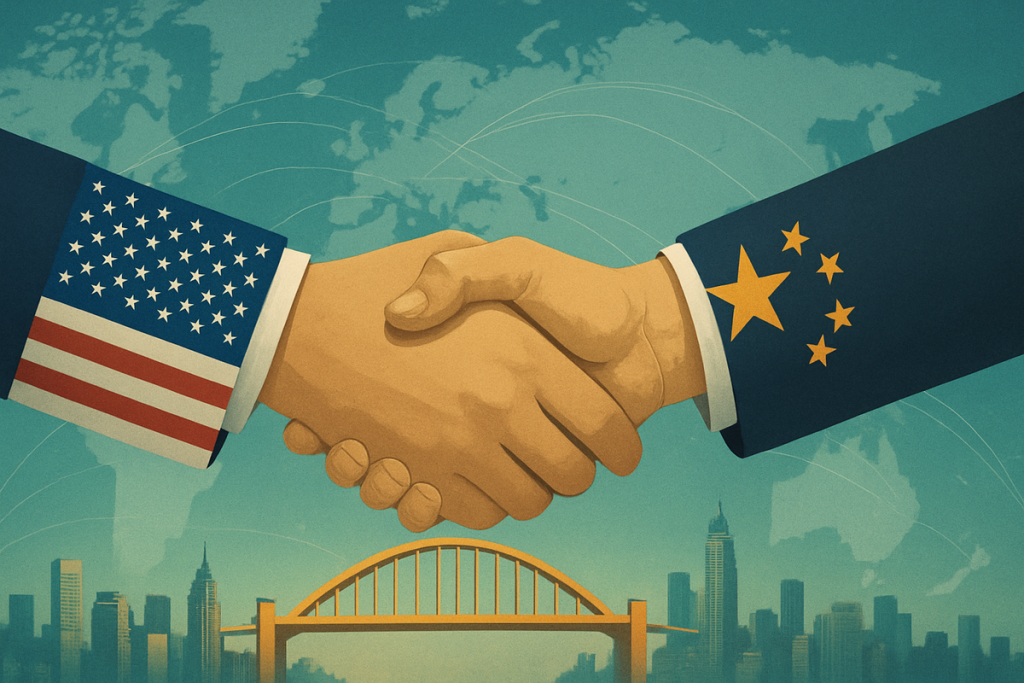
Global equities rally as a U.S.–China trade de-escalation coincides with renewed investor appetite for artificial-intelligence investment
New York / London, November 3, 2025
Global financial markets rallied sharply today as two major catalysts converged: a tentative trade truce between United States and China, and renewed optimism about the commercial potential of artificial-intelligence (AI) investment. The lift across equities, commodities and risk assets reflects a shift in investor sentiment toward risk-on behaviour — though notable structural risks remain beneath the surface.
Trade détente provides relief
The backdrop for today’s rally was the announcement that the U.S. and China have stepped back from a further escalation of tariffs and trade restrictions, effectively implementing a year-long truce on major trade frictions. While no sweeping, fully detailed long-term treaty has been signed, the market’s response has been strong: the sense that at least one major geopolitical shock-point has been deferred.
In Asia alone, the broad MSCI Asia-Pacific index outside Japan rose about 0.63 %, nearing a four-and-a-half-year high and putting it more than 27 % up for the year. The gains were evident in South Korea (new record high) and in Hong Kong’s Hang Seng Index.
This trade de-escalation is important because exposure to U.S.-China supply-chain friction, tariffs, and export restrictions had been a drag on business sentiment, corporate investment and global growth. The truce doesn’t erase those issues, but it reduces one major overhang.
AI investment fuels the optimism
Parallel to the trade story is a surge in investor enthusiasm for AI-driven growth. With tech firms such as Amazon reporting accelerating cloud growth tied to AI, and others ramping up AI infrastructure spend, the narrative that AI is transitioning from hype to commercialisation is gaining traction.
Against this backdrop, investors are willing to favour growth sectors, even amid concerns about broader macro weakness. Tech-heavy indices show participation, and the message is clear: artificial intelligence is becoming a key driver of the current risk-appetite cycle.
Divergence beneath the surface
That said, the strength of the rally masks underlying fragility and structural questions. For example, despite broader market gains, many manufacturing and export-oriented economies remain weak. October manufacturing PMIs in China continued to soften, highlighting that the global growth engine is not yet back to robust condition.
Additionally, while headline equity gains are strong, breadth is not uniformly strong. Some strategists note that much of the rally is concentrated in a handful of large technology companies tied to AI, while equal-weighted indices lag significantly.
Macro, currency and commodity dynamics
The trade and AI optimism isn’t just pushing equities higher—it’s also influencing currencies and commodities. The U.S. dollar strengthened to a three-month high as markets dialled down expectations of imminent interest-rate cuts by the Federal Reserve. Meanwhile, gold rebounded above the USD 4,000 mark per ounce, oil prices edged up on supply tensions, and copper and industrial-metal prices remain sensitive to the soft-growth backdrop.
Implications for investors and markets
For investors, the dual themes of trade respite and AI-driven growth suggest a few actionable take-aways:
- Growth exposure remains key: Given the AI momentum, sectors tied to semiconductors, cloud infrastructure, data centres and machine-learning applications are likely to remain in focus.
- Risk-on, but with hedge: While sentiment is stronger, the underlying landscape is mixed. Weak manufacturing data and the possibility of renewed trade or geopolitical shocks argue for hedging and careful position sizing.
- Currency and yield awareness: A stronger dollar and possibility of fewer rate-cuts than expected mean investors need to monitor currency risks (especially outside the U.S.), and fixed-income portfolios should account for yield-curve pressures.
- Supply-chain and commodity links matter: Export-heavy economies and commodity producers remain vulnerable to global demand softness; selectivity is required.
- Caution with valuations: With large parts of the rally concentrated in a few names, overvaluation risk is increasing. Some markets may be pricing in very positive assumptions.
What to watch next
Key upcoming risk-points for markets include:
- Follow-through in the U.S.–China trade relationship. If the truce holds and leads to further concretisation (e.g., tariff roll-backs, supply-chain cooperation), it could sustain the rally. If it unravels, sentiment could reverse sharply.
- Corporate earnings and AI monetisation. Investors will be watching whether companies actually deliver strong returns on their AI investments. The transition from hype to profits matters.
- Macro data flow. Manufacturing, export and domestic demand indicators in China, the U.S. and Europe will test whether momentum is broadening. The softness in China’s PMIs is a caution flag.
- Central-bank policy and interest-rate expectations. If the Fed or other major banks alter guidance, that could shift the risk-on backdrop substantially.
- Geopolitical or supply-chain shocks. Markets may be enjoying a “calm before the storm” scenario—any shock could reignite risk-off behaviour given the elevated positioning.
Why this matters globally
The fact that markets are rallying on a trade truce and AI optimism underscores how deeply interlinked geopolitics, technology and capital markets have become. The U.S.-China axis remains arguably the most significant bilateral economic relationship in the world; a decent outcome there influences global supply chains, corporate strategy, and capital flows. Similarly, AI is no longer a niche theme—it has evolved into a structural growth narrative influencing everything from chip demand to enterprise software and cloud services.
If the current optimism broadens into a durable cycle of growth, investment and trade normalisation, the ripple effects could be substantial: improved global demand, higher corporate capex, and rising cross-border transactions. But if either leg falters—trade policy re-escalates, or AI expectations disappoint—the risk of reversal is meaningful.
Final thoughts
The rally today in global markets is welcome, and the twin drivers of trade détente and AI investment are powerful. But this moment should not be mistaken for a full recovery or risk-free terrain. Underneath the surface, growth remains patchy, divergence pronounced, and structural issues unresolved. Investors should embrace the upside, but remain vigilant and disciplined.
Source:


