U.S.-China Sign One-Year Rare Earths Deal, Trump Rates Xi Meeting
News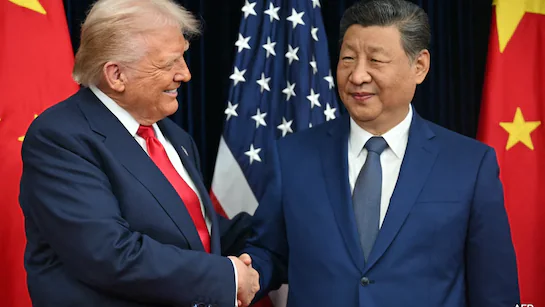
In their first face-to-face encounter since 2019, Donald Trump and Xi Jinping struck a one-year agreement on rare earth supplies and eased some tariffs, with Trump declaring the summit “12 out of 10”.
Busan, South Korea
The United States and China have reached a pivotal one-year agreement on the supply of rare earths, marking a tentative thaw in their prolonged trade confrontation. President Trump and President Xi signed the deal on the sidelines of the 2025 APEC Summit in Busan, with Trump then calling the meeting a “12 out of 10”.
According to U.S. officials and Chinese state media, the pact obliges China to maintain its supply of rare-earth elements to the U.S. and global markets for at least one year, while the U.S. agreed to roll back certain tariffs.
China’s measure includes postponing its previously announced export restrictions on rare earths, which are critical for high-tech manufacturing, semiconductors and defence systems. Meanwhile, the U.S. will reduce its tariff on Chinese goods tied to fentanyl-precursor chemicals from 20 % to 10 % and lower its overall China-tariff average from 57 % to around 47 %.
Why rare earths matter
Rare earth elements—and their processed forms—play outsize roles in advanced technologies: everything from electric vehicles and wind turbines to missile guidance systems and smartphones depends on them. China currently dominates the mining and processing chain, giving it strategic leverage.
Beijing’s planned export curbs in early October rattled markets, especially in the U.S., which viewed them as a geopolitical flashpoint. The new deal effectively places those curbs on pause and restores a measure of supply-chain stability—for now.
Key provisions and challenges
- Supply guarantee: China will maintain rare-earth exports for one year under the deal. Implementation details remain opaque.
- Tariff relief: The U.S. will ease tariff pressure on China, specifically cutting the 20 % fentanyl-related tariff to 10 %.
- Agricultural linkages: China pledged to resume substantial soybean purchases from U.S. farmers as part of the broader package.
- Annual review: Trump said the deal is extendable each year—but both sides emphasised it is a temporary framework, not a long-term treaty.
Still, analysts caution that major issues remain unaddressed—including U.S. export controls on high-tech goods to China, broader intellectual-property disputes, and structural trust deficits.
Market and political reactions
Financial markets welcomed the de-escalation, if cautiously. Rare-earth stocks saw modest gains and broader Asian markets edged upward. But analysts emphasised the one-year nature of the deal and cautioned that underlying tensions between the two superpowers persist.
Politically, the meeting signals an uptick in diplomacy. Trump announced plans to visit China in April 2026, with Xi expected to travel to the U.S. later. Nevertheless, hard-liners on both sides remain sceptical of the deal’s durability.
Global implications
A stable rare-earth supply line from China for the next 12 months matters for global manufacturers, especially in the U.S., Europe and Asia. Industries reliant on magnets, batteries, turbines and defence systems breathed easier after the deal.
Yet the pause on export controls may only be temporary. China retains leverage through its dominant mining and processing base, and could reintroduce restrictions if bilateral tensions flare again. Experts note that broader diversification efforts—from Australia, Africa and the U.S.—must accelerate.
What to watch
- Enforcement: Will China deliver on rare-earth supply without discrete export curbs or licensing bottlenecks?
- Tariff follow-through: Will the U.S. implement the promised tariff cuts and link them to broader trade concessions?
- High-tech access: How will the U.S. respond to Chinese restrictions on semiconductors and critical-material exports that remain unaddressed?
- Supply-chain diversification: Will U.S. and allies invest in alternative mining and processing outside China?
- Political continuity: With presidential campaigns heating up in both countries, will leaders maintain momentum on the agreement or revert to traditional trade postures?
Verdict
The one-year rare-earths agreement between the U.S. and China represents a short-term reprieve rather than a long-term solution. It stabilises a volatile supply chain and signals improved trilateral diplomacy—but it stops short of resolving the deep, structural friction between the world’s two largest economies.
As Trump described the meeting with Xi as “12 out of 10,” observers must judge the outcome not by rhetoric, but by tangible supply-chain flows, tariff behaviour and technology-access decisions in the coming months.
Source:


